



Why Hollow Core Doors Are a Security Risk
Knowing how to reinforce a hollow core door starts with the problem: a lightweight frame and a honeycomb or particle board core under thin wood veneer, cheap, light, and weak.
How to Tell If Your Door Is Hollow Core
Knock on the door. Hollow core sounds thin and echoey; solid core or solid wood sounds dull and heavy.
Other quick checks:
- Look at the top edge for a visible seam where the two skins meet.
- Check the weight, hollow core doors feel light when you open them.
- Check the thickness, most hollow core interior doors are about 1-3/8 inches thick.
- Check the label or original builder paperwork if you have it.
U.S. Department of Justice home burglary statistics
Tools and Materials You Need Before You Start
Gather everything before you pick up a drill, a mid-job hardware store run kills momentum.
Basic tools:
- Cordless drill with a Phillips bit and a 1/8-inch drill bit
- Tape measure and pencil
- Chisel or oscillating tool for trimming the jamb
- Screwdriver set
- Safety glasses
Materials:
- 3-inch wood screws (at least four)
- A reinforced strike plate or door frame reinforcement kit
- Toggle anchors rated for the door slab thickness
- Wood filler and wood glue
- Wooden dowels (1/4-inch or 3/8-inch) for patching stripped holes
- A deadbolt, security bar, or door jammer
- Shims for the hinge side
Pro Tip: Buy extra 3-inch screws. You will strip one or drop one inside the wall cavity. Having spares saves a second trip.
Step 1: Replace Strike Plate Screws With 3-Inch Long Screws
The fastest upgrade is swapping the short strike plate screws for 3-inch screws, about five minutes and almost no cost.
How to do it:
- Remove the two short screws holding the strike plate.
- Line up the plate and drive a 3-inch screw into the top hole.
- Drive a second 3-inch screw into the bottom hole.
- Tighten until the plate sits flush against the jamb.
Why Short Screws Fail During a Kick-In
A short screw holds only about an inch of soft jamb wood, often pine or composite. Under a hard kick, it tears through the grain and the plate pops off.
Step 2: Install a Reinforced Strike Plate and Door Frame Reinforcement
A reinforced strike plate spreads kick force across a larger area of the jamb, keeping the frame from splitting.
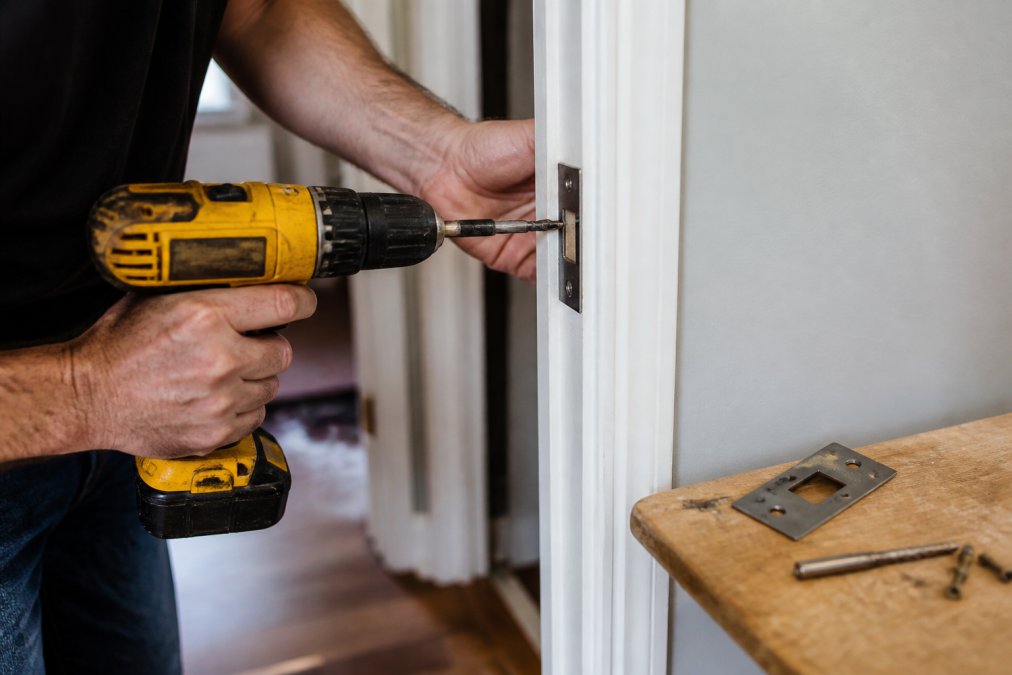
Hands using a drill to drive long screws into a metal strike plate on a wooden door jamb
Installation steps:
- Remove the old strike plate and screws.
- Hold the new plate against the jamb and mark the screw holes.
- Drill pilot holes with a 1/8-inch bit.
- Drive 3-inch screws through the plate into the stud.
- Check that the deadbolt or latch still seats fully into the plate.
What a Hollow-Core Slab Can and Cannot Do
Before mounting anything on the door, understand the limit: a hollow-core slab is a thin veneer skin (often 1/8 inch or less) over a lightweight frame and honeycomb or particle board core, with no solid mass behind the skin.
Using Toggle Anchors on the Hollow Slab
Toggle anchors are the correct slab fastener because they expand behind the skin and spread the load wider than a plain screw. Use them for surface-mounted hardware like a door jammer bracket or security bar mount.
How to set a toggle anchor in a hollow door:
- Drill a hole sized to the anchor's barrel (check the package, usually 3/8 or 1/2 inch).
- Insert the toggle through the hole and let it flip open behind the skin.
- Pull the anchor tight against the inside of the skin.
- Snap off the excess strap flush with the door face.
- Drive the machine screw into the anchor.
Watch Out: Never rely on toggle anchors alone for the main lock. They help with hardware on the slab, but the primary security comes from the frame and stud reinforcement. A toggle anchor in a hollow slab will pull through under a hard kick.
Repairing Stripped Hinge Screws in Particle Board
This is the failure most guides skip. Hollow-core doors and frames often use particle board or composite jamb material that crumbles when a screw is over-torqued or works loose from sagging. Once stripped, a new screw will not hold.
- Remove the hinge and the stripped screw.
- Clean out the old hole with a drill bit slightly larger than the screw shank, remove the crumbled material, not just the screw.
- Squeeze wood glue into the hole and let it soak the surrounding fibers.
- Tap in a wooden dowel (1/4-inch or 3/8-inch, matched to the hole) coated in glue.
- Let it cure fully, at least a few hours, ideally overnight.
- Trim the dowel flush with a chisel or flush-cut saw.
- Drill a new pilot hole (slightly smaller than the screw) and reinstall the hinge.
Step 3: Reinforcing Door Hinges for Security
The hinge side is the forgotten half of door security. If the hinges fail, the door swings open even if the lock holds, and on a hollow-core door the jamb is often particle board or thin composite that strips out under load.
What to do:
- Replace the two screws closest to the door stop on each hinge with 3-inch screws. These reach past the jamb into the wall stud.
- Add a hinge reinforcement plate if the jamb wood is soft or damaged.
- Check that all hinge screws are tight. Loose hinges let the door sag and misalign the lock.
- If a screw spins freely, the hole is stripped, repair it with the dowel-and-glue or epoxy method before adding longer screws.
Why Hollow-Core Hinge Sides Fail First
The hinge side takes more stress than the strike side during normal use. Every swing makes the top hinge a lever, working its screws against the jamb material, frequently particle board, which holds a screw when new but crumbles once it works loose.
Hinge-Side Jamb Reinforcement and Flush Bolts
For a stronger setup, add hinge-side jamb reinforcement, a steel plate along the hinge side that ties the hinges together and spreads load across the full jamb height instead of two screw holes.
Aesthetic-Friendly Reinforcement for Interior Doors
Most reinforcement hardware is built for entry doors and looks like it, heavy steel plates, exposed screws, industrial finishes. Fine on a front door, a problem on a bedroom or home office door where the look matters.
Options that keep the door looking normal:
- Color-matched strike plates. Many reinforcement plates come in finishes that match common door hardware (satin nickel, oil-rubbed bronze, matte black). Choose a plate that matches your existing knob or lever so the upgrade disappears.
- Long screws only, no visible plate. If the existing strike plate is already decent, swapping the short screws for 3-inch screws is invisible and adds most of the benefit.
- Hinge-side long screws. Same principle, no visible hardware, just longer screws into the stud.
- A door jammer used only when needed. A portable jammer stores in a drawer and only appears when you want it. For a renter or a home office, this is the least visually intrusive option.
- A solid-core replacement slab. If the door is interior and the look matters, replacing the hollow slab with a solid-core slab of the same size and finish is the cleanest long-term fix. It costs more than hardware, but it removes the hollow-core weakness entirely and looks identical.
Key Takeaway: The best interior reinforcement is the kind no one notices. Match your existing finish, lean on long screws and hinge-side upgrades, and save the visible steel for the entry door.
Step 4: Add a Deadbolt, Security Bar, or Door Jammer
A deadbolt is the backbone of door security. It throws a solid bolt deep into the frame, unlike a spring latch that can be slipped with a credit card.
Deadbolt tips:
- Choose a bolt with at least a 1-inch throw.
- Make sure the strike plate for the deadbolt is reinforced with long screws.
- Grade 1 deadbolts offer the highest impact resistance.
Key Takeaway: Layer your defense. A deadbolt, a reinforced strike plate, and long screws into the stud work together. No single upgrade does the job alone.
Best Door Reinforcement Kits and How to Choose One
The best door reinforcement kits combine a reinforced strike plate, jamb reinforcement, and hinge-side protection in one package, with heavy-gauge steel and 3-inch screws included.
What to check before you buy:
- Material: galvanized or heavy-gauge steel holds up better than thin plate
- Coverage: does it protect the strike side, the hinge side, or both?
- Hardware included: screws, anchors, and plates
- Fit: does it work with your door slab thickness and frame size?
- Install time: most kits claim under an hour
| Feature | What to Look For | Why It Matters |
|---|---|---|
| Material | Galvanized steel | Resists bending and rust |
| Jamb coverage | Wraps the corner | Stops frame splitting |
| Screw length | 3 inches or longer | Reaches the wall stud |
| Hinge protection | Plates or long screws | Stops hinge-side failure |
| Install time | Under 1 hour | DIY-friendly |
FEMA guidance on securing doors against forced entry
How Long Does It Take to Reinforce a Door?
Reinforcing a door takes about 30 to 60 minutes for a basic upgrade, and up to two hours for a full kit with a deadbolt, depending on your tools and the frame's condition.
Time breakdown:
- Swapping strike plate screws: 5 to 10 minutes
- Installing a reinforced strike plate: 20 to 30 minutes
- Hinge reinforcement: 15 to 20 minutes
- Deadbolt install: 30 to 45 minutes
- Full kit install: 30 to 60 minutes
National Crime Prevention Council home security tips
Frequently Asked Questions
Can you put screws in a hollow core door?
Yes, but standard screws will strip out of the thin particle board or cardboard honeycomb inside a hollow core door. Use toggle anchors or molly bolts that expand behind the door slab to create a secure hold. For strike plates and hinges, drive 3-inch screws through the door frame and into the wall studs behind it. This anchors the hardware to the home's structural framing rather than the fragile door slab itself.
Are hollow core doors worth reinforcing for security?
They are worth reinforcing, but only if you address the door frame and jamb, not just the slab. A hollow core door slab will split under a hard kick regardless of hardware. The frame and strike plate are the real weak points. Reinforcing the jamb with long screws, a reinforcement plate, and hinge-side support turns a hollow core door into a meaningful barrier that buys time against forced entry.
How can I fix a damaged hollow core door after a break-in?
For splintered screw holes, push wood filler or a wooden dowel coated in wood glue into the damaged area, let it cure, then re-drill a pilot hole. For larger cracks in the door slab, epoxy wood filler works better than standard filler. If the door frame itself is cracked, a reinforcement plate that spans the damaged section can restore structural integrity without replacing the entire frame.
What is the best door reinforcement kit for a hollow core door?
Look for a kit that includes a reinforced strike plate, jamb shield, and hinge-side reinforcement, not just longer screws. Door Armor's galvanized steel system covers all three weak points and installs in under 30 minutes without removing the door. Kits that only replace screws leave the jamb and hinge side exposed. Check that the kit fits your door thickness and hardware before ordering.