



How Motion-Activated Lighting Works Against Burglars
Motion lights deter burglars by creating the illusion that someone is home and alert. When sudden illumination floods the area, burglars assume occupants are present, a powerful deterrent since most operate in darkness, relying on concealment to avoid detection.
A passive infrared sensor detects body heat and movement, activating the light instantly. This illumination exposes the intruder to potential witnesses and increases their risk of identification, burglars actively avoid well-lit properties.
Passive Infrared Sensors and Detection Zones
PIR sensors detect heat signatures and trigger lights when warm bodies move through the detection zone. Most residential sensors have a 30 to 40-foot range and detect movement across 120 to 180 degrees.
Proper calibration prevents false alarms from animals or debris while reliably detecting human movement. Understanding your sensor's range helps position lights strategically around entry points.
The Psychology of Sudden Illumination
Burglars scout properties at night for unlit areas. When motion lights activate, that advantage disappears instantly, forcing a quick decision to proceed or retreat, most choose to retreat.
Motion lights signal active occupancy and awareness. Even on vacant properties, sudden illumination creates doubt, often enough to send intruders elsewhere.
Pro Tip: Layer your motion lighting with other visible security measures. A motion light combined with a security camera or alarm system signage amplifies the deterrent effect because burglars see multiple layers of protection they'd have to breach.
Best Home Security Lighting Placement for Maximum Coverage
Strategic placement eliminates dark hiding spots and covers all potential entry points. Identify routes an intruder would take and areas offering concealment.
Prioritize entry points (front door, back door, sliding glass doors, ground-floor windows) with direct illumination. Cover secondary areas like side yards and garage entrances where burglars scout.
Eliminating Dark Hiding Spots Around Entry Points
Dark hiding spots, thick bushes, shadowed corners, unlit pathways, create approach opportunities. Motion lights eliminate these by flooding areas with sudden illumination.
Position lights above or to the side of entry points so they activate as someone approaches. Ensure no approach route remains dark, intruders should encounter illumination before reaching doors.
Aim for lights that create a visible perimeter around the entire structure, not just interior illumination.
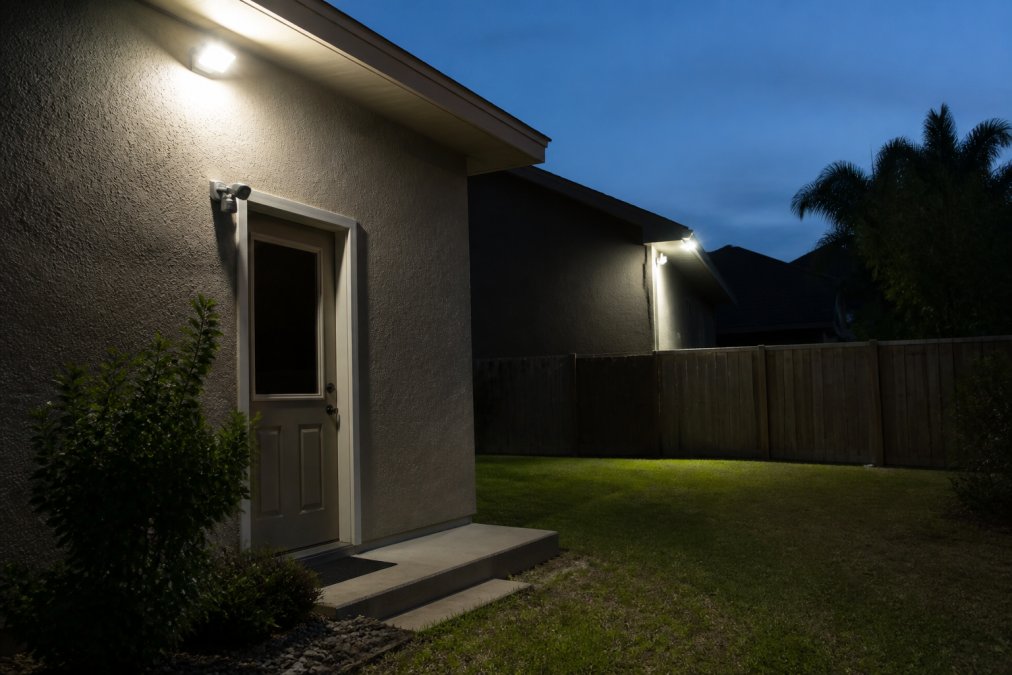
Exterior home at dusk showing motion-activated floodlights mounted on corners illuminating a dark backyard with sensor visible near an entry point, creating bright zones around the perimeter
Sensor Range and Perimeter Security Strategy
Plan placement assuming 25 to 30 feet of reliable detection in real-world conditions, accounting for obstacles like walls and landscaping.
Three to five motion lights typically provide comprehensive coverage: front entrance, back door, side yard/driveway, and other vulnerable access points. Create overlapping detection zones so intruders can't approach entry points without triggering illumination.
Key Takeaway: Motion lights deter burglars most effectively when they cover the entire approach to entry points. Gaps in coverage create opportunities for concealment, undermining the deterrent effect.
Motion Sensor Light vs Constant Light for Security
Motion-activated lighting outperforms constant illumination because it signals occupancy and awareness. Constant lights appear predictable, simply lit all night regardless of occupancy.
Motion lights signal active detection, creating the impression someone noticed movement. This perception of active monitoring is far more intimidating than steady illumination, and motion lights are more energy-efficient.
Constant lighting creates predictable shadows and safe approach routes. Motion lights eliminate this advantage by responding dynamically to movement.
How to Secure Entry Points Against Forced Entry
Motion lighting deters casual intruders but determined burglars may still attempt entry. Combining motion lights with physical reinforcement creates stronger defense.
Combining Motion Lighting with Physical Reinforcement
Physical reinforcement stops those who ignore the deterrent. Door Armor reinforces the strike plate and door frame, making kick-ins significantly more difficult.
Motion lighting deters casual attempts and alerts you to threats. Physical reinforcement stops determined attackers. Together they address both deterrence and resistance to forced entry.
Door Armor reinforces the strike plate and door frame. Combined with motion-activated lighting, it creates multiple protection layers: the light activates on approach, and the reinforced door stops kick-in attempts.
Reducing False Alarms and Managing Sensor Sensitivity
False alarms cause alarm fatigue, leading homeowners to disable systems entirely. Understanding how to tune your system prevents this failure mode.
Identifying and Eliminating Common False Triggers
Pets and wildlife: Position sensors 6 to 8 feet above ground to reduce pet-triggered activations. Many modern sensors include pet-immunity settings that filter out movement below 40 to 50 pounds.
Wind-blown vegetation: Avoid pointing sensors at dense vegetation. Angle them downward toward approach routes and entry points instead.
Vehicle headlights: Reposition sensors to face entry points rather than street-facing areas, or adjust detection zones to exclude driveway perimeters.
Sensor Adjustment and Calibration
Sensitivity adjustment: Start with moderate sensitivity and test by walking through the detection zone at different distances. A properly tuned sensor activates at 20 to 30 feet during normal walking speed but not when stationary. Adjust incrementally as needed.
Activation duration: Set 2 to 3 minutes for security, long enough to deter intruders, short enough to avoid constant activation from passing traffic.
Maintenance and Sensor Longevity
Sensor performance degrades without maintenance. Dust and debris reduce detection accuracy, causing false alarms or missed detections.
Quarterly cleaning: Inspect lenses every three months and wipe with a soft, dry cloth. Use distilled water for stubborn debris. Avoid abrasive materials or harsh chemicals.
Bulb replacement: LED bulbs last 25,000 to 50,000 hours. Check bulbs annually and replace immediately if they fail. Keep spares on hand.
Sensor repositioning: Review placement annually and adjust if landscaping has changed significantly.
Watch Out: Frequent false alarms train you to ignore the lights, eliminating the psychological deterrent effect. If your system triggers more than a few times per night, adjust sensitivity or reposition sensors before disabling the system entirely. A non-functional security light provides zero protection.
When to Replace Versus Repair
If a sensor consistently malfunctions, replacement is typically more cost-effective than repair. Quality fixtures cost $30 to $80 per unit. Budget for replacement every 7 to 10 years as routine maintenance.
Energy Efficiency and Long-Term Cost Savings
Modern LED motion lights consume minimal electricity, operating only when movement is detected. On-demand operation keeps energy costs low even with perimeter coverage.
LED motion lights draw 10 to 15 watts when active, compared to 50 to 100 watts for older models. Annual energy savings are substantial.
Motion-activated security systems can reduce homeowner's insurance premiums.
Smart Home Integration and Modern Security Lighting
Smart motion lights integrate with home ecosystems, adding capabilities beyond mechanical systems. However, they introduce trade-offs deserving careful consideration.
Real-Time Monitoring and Remote Alerts
Smart motion lights send phone notifications, activate cameras, log events, and trigger additional actions. This transforms motion lighting from passive deterrent to active monitoring. Real-time visibility lets you determine if activation is legitimate or a security threat.
Scheduling and Occupancy Simulation
Smart motion lights enable scheduling and automation: activate during specific hours, adjust sensitivity by time of day, and create randomized patterns that simulate occupancy.
Integration with Broader Security Ecosystems
Security system hubs: When a motion light triggers, it can send a signal to your security system hub, which logs the event and can trigger additional responses (arm/disarm modes, alert notifications, etc.). This creates a unified security dashboard where all events, motion detection, door/window sensors, camera activity, appear in one place.
Trade-Offs and Limitations of Smart Integration
Smart motion lights offer significant advantages, but they introduce complexity and potential vulnerabilities that traditional motion lights do not have.
- Using strong, unique passwords for your smart home account
- Enabling two-factor authentication if available
- Keeping firmware updated (most systems push updates automatically)
- Choosing systems from manufacturers with transparent security practices
When Smart Integration Adds Value
Smart motion lights are most valuable when:
- You have frequent extended absences and want to simulate occupancy remotely
- You have existing smart home infrastructure (hub, security system) that the lights can integrate with
- You want real-time alerts and camera integration for active monitoring
- You're willing to manage the additional complexity and cybersecurity considerations
For homeowners who simply want reliable motion-activated deterrence without remote monitoring, traditional motion lights remain highly effective and eliminate the connectivity and security concerns of smart systems. The deterrent value of sudden illumination is identical whether the light is smart or traditional. The difference is in monitoring capability and automation, not in the core security benefit.
Key Takeaway: Smart motion lights enhance security through real-time monitoring and occupancy simulation, but they introduce connectivity dependencies and cybersecurity considerations. Choose smart integration if you value remote monitoring and automation; choose traditional motion lights if you prioritize simplicity and reliability.
Frequently Asked Questions
Do motion sensor lights actually deter burglars?
Yes. Motion-activated lights eliminate dark hiding spots and trigger unexpected illumination when intruders approach, creating the impression that someone is home. This sudden activation forces burglars to make split-second decisions under exposure, significantly increasing their perceived risk. The combination of nighttime visibility and automatic activation makes properties far less attractive targets compared to homes with constant darkness or no security lighting at all.
Where should you place motion sensor lights for maximum security?
Install motion lights at all entry points: front doors, back doors, side gates, and near ground-level windows. Position sensors 6-10 feet high to cover the full approach path and eliminate dark hiding spots around the perimeter. Ensure the detection zone extends at least 15-20 feet outward to trigger early. Test the sensor range during installation to confirm coverage of vulnerable areas where intruders might linger or attempt forced entry.
Is motion sensor lighting better than leaving a constant light on?
Motion sensors are superior for intruder deterrence and energy efficiency. Constant lights become part of the environment and don't signal active occupancy. Motion-activated lights create the impression of sudden detection and response, which is psychologically more effective at deterring burglary risk. Additionally, LED motion lights use significantly less electricity since they only activate during unexpected movement, reducing your energy costs while maintaining 24/7 crime prevention capability.
Can motion lights be fooled by weather or animals?
False alarms from wind, rain, or passing animals are common with poorly positioned or overly sensitive sensors. Reduce false triggers by adjusting sensor sensitivity, positioning lights to avoid direct wind exposure, and ensuring detection zones don't include areas where animals frequently pass. Modern smart motion lights let you set custom schedules or adjust sensitivity remotely, providing better control over false alarms while maintaining effective intruder deterrence at critical hours.