



Last Updated: September 17, 2026
Your First-Week Home Security Checklist for New Homeowners
A home security checklist for new homeowners works best in the first week, before boxes are unpacked and routines settle. At Door Armor, we've spent 20+ years securing entry points, and the pattern is clear: most break-ins happen through doors, not windows, and most new owners never check whether their locks were ever changed.
Why the First 30 Days Matter Most
Your move-in window is when your home is most exposed. Furniture is still in boxes, routines aren't established, and you haven't met the neighbors who'd normally notice something odd.
Watch Out
Don't hand out keys to movers, cleaners, or contractors without tracking who has them. Unreturned keys are one of the most common ways a new home's entry points stay vulnerable months after move-in.
1. Change the Locks and Re-Key Every Entry Point
Re-keying is cheaper than replacing locks and achieves the same result: old keys stop working. A locksmith can re-key standard cylinders so your existing hardware stays in place.
Walk every exterior door and confirm:
- Front, back, side, and garage entry doors are all re-keyed
- Sliding glass doors have a working secondary lock
- Spare keys are accounted for, not hidden under a mat
2. Reinforce Doors and Windows: Best Door Reinforcement for Home Security
The best door reinforcement for home security targets the door frame, not the lock. A deadbolt is only as strong as the wood it's screwed into, and most residential frames split on the first solid kick.
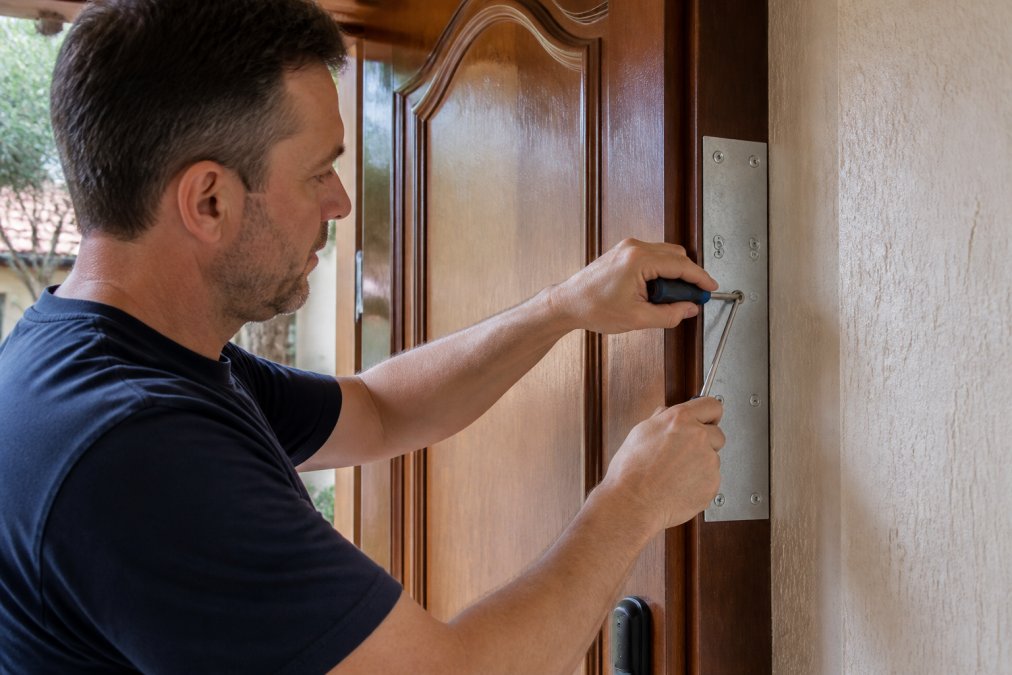
Homeowner using a screwdriver to install a steel door reinforcement plate as part of a home security checklist.
Door Armor Kits by Door Type
Not every door needs the same hardware. Here's how the options map to common entry points:
| Door Type | Recommended Kit | Price | Best For |
|---|---|---|---|
| Single exterior door | Door Armor Single Door Security Set | $79.00 | Standard front or back doors up to 1-3/4" thick |
| Door with side lights | Door Armor Side Light Door Security Kit | $129.00 | Sidelight doors with no true jamb |
| Double doors | Door Armor Double Door Security Kit | $149.00 | French and double entry doors; includes Night Lock barricade |
| Sliding glass door | Armor Latch Sliding Door Deadbolt | $39.99 | Patio doors that can be lifted off the track |
Window Locks and Sliding Glass Door Security
Ground-floor windows and sliding doors are the second-most common entry point after doors. Add window sensors or pin locks, and use a deadbolt made for sliding doors so the panel can't be lifted out of its track.
3. Install Smoke and Carbon Monoxide Detectors
Install a smoke detector on every level of the home, inside each bedroom, and outside sleeping areas. Place carbon monoxide detectors near sleeping areas and on any level with a fuel-burning appliance or attached garage.
4. Set Up a Monitored Security System and Cameras
A monitored system calls for help when you can't. Before you sign anything, understand the three models, because the contract terms matter as much as the hardware.
- Professional monitoring: A central station receives alerts and dispatches police, fire, or medical. Typically requires a one- to three-year contract, and the equipment may be proprietary, so switching providers later can mean replacing hardware.
- Self-monitoring: The system pushes alerts to your phone and you decide whether to call 911. No monthly contract, but you are the dispatcher, which fails if you're asleep, driving, or offline.
- Hybrid: Self-monitoring by default with optional professional monitoring you can toggle on for vacations. This is the most flexible and increasingly common.
Wired vs. DIY vs. Professionally Installed
| Approach | Typical Upfront Cost | Ongoing Cost | Trade-off |
|---|---|---|---|
| DIY kit | $200-$500 | $0-$25/mo if self-monitored | Cheapest, but you place and mount every sensor |
| Professional install | $500-$1,500+ | $30-$60/mo monitoring | Cleaner install, longer contract |
| Hybrid | Varies | Pay only when monitoring is active | Most flexible, slightly more setup |
If you go DIY, start with door and window sensors on ground-floor entry points, then add motion sensors in hallways and near the top of basement stairs. Skip motion sensors in rooms where pets sleep, most modern sensors have pet-immune settings, but confirm the weight limit before buying.
Security Camera Placement and Night Vision
Put cameras at every exterior entry point first, then cover the driveway, back door, and any blind spots along the perimeter. A high-definition camera with night vision should capture faces, not silhouettes.
- Mount cameras 8-10 feet high and angle them slightly downward so a hat brim doesn't hide the face.
- Keep cameras out of direct porch-light glare; infrared reflects off glass and washes out the frame.
- Check the footage at night before you trust it. A camera that looks sharp at noon can be a gray blur at 2 a.m.
- Confirm whether your cameras record locally (a hub or SD card) or to the cloud, and whether that cloud plan has a monthly fee.
The Step Most Checklists Skip: Secure the Smart Home Network
- Change the default router admin password and the default Wi-Fi password the day your internet is activated. Default credentials are published online.
- Put smart devices on a separate network. Many routers support a guest network or a dedicated IoT network. If a camera is compromised, it can't reach your laptop.
- Enable WPA3 or WPA2 encryption on the router, and turn off WPS, which is easy to brute-force.
- Update firmware on the router and each device. Manufacturers patch vulnerabilities, but only if you install the update.
- Turn on two-factor authentication for every smart-home app account, especially anything tied to a lock or garage door.
- Disable remote access on devices you don't need to control from outside the home.
Watch Out
A video doorbell with the factory password is a camera anyone on your network can watch. Change the password before you mount it, not after.
If you inherited smart devices from the previous owner, see the privacy audit section below before you connect them, you may be handing over access to someone else's account.
5. Outdoor Lighting, Landscaping, and Perimeter Security
Perimeter lighting is one of the cheapest intruder deterrence tools you have. Motion-sensor lights at each entry point and along dark walkways remove the cover an intruder needs.
Door Armor Single Door Security Set →
Pro Tip
Set porch and perimeter lights on a timer or smart plug rather than leaving them on constantly. Constant light reads as "nobody's home" after a few days, while a schedule looks lived-in.
6. How to Make Your Home Look Occupied When Away
Learning how to make your home look occupied when away comes down to breaking predictable patterns. Burglars watch for routine: the same lights off at the same time, mail piling up, and an empty driveway for a week.
Simple habits that work:
- Put interior lights on timers that vary by day
- Pause mail and package delivery for trips over three days
- Ask a neighbor to park in your driveway
- Leave a radio or TV on a timer for short trips
7. Secure Valuables, Safes, and Emergency Shut-Offs
Safes and Valuables
A safe bolted to the floor beats a safe sitting in a closet. A burglar with five minutes and a hand truck can walk out with an unbolted 200-pound safe; the same safe lag-bolted into a concrete slab usually gets left behind.
- Fire-rated vs. burglary-rated: Fire ratings protect paper and drives from heat; burglary ratings (TL-15, TL-30) describe how long the door resists tools. Most homeowners need fire protection first and a modest burglary rating second.
- What to store: Passports, birth certificates, titles, jewelry, backup drives, and a written inventory of serial numbers and account details.
- Keep a copy off-site. A safe deposit box or an encrypted cloud folder holds the inventory and document copies so a fire or theft doesn't take both the items and the record of them.
Emergency Shut-Offs
Locate these before you need them, and label them so a house sitter or contractor can find them too:
- Water main: Usually near the street in a curb-stop box, or where the supply line enters the basement or crawlspace. Test the valve once, old gate valves seize.
- Gas shut-off: At the meter or at the appliance. Know which one your utility expects you to use in an emergency; some utilities ask you to call before touching the meter valve.
- Electrical panel: Label every circuit. An unlabeled panel costs you an hour in the dark during a storm.
The Post-Move-In Privacy Audit
This is the step most checklists skip entirely, and it's the one that matters most in a home that was previously occupied or wired with smart devices.
Reset digital access the previous owner may still have:
- Smart locks and garage openers: Factory-reset each device and re-pair it to your account. A previous owner's app can still open a lock that was never reset.
- Video doorbells and cameras: Remove the old account, then add yours. Check the device's cloud history for any clips you didn't record.
- Thermostats, smart plugs, and hubs: Reset and re-provision. Shared accounts are common and easy to overlook.
- Wi-Fi router: If the previous owner left the router, factory-reset it and set new admin and network passwords. If your internet provider supplied it, ask them to reprovision it under your account.
Update your address and reduce exposure:
- File a change of address with the postal service and update your bank, insurance, and employer.
- Check whether your home address and phone number appear on people-search sites, and request removal where the site allows it.
- Review privacy settings on any smart home app before it goes online, location sharing, camera access, and voice recording are the three to check first.
Key Takeaway
The privacy audit is a one-time task with a long tail. Do it in your first week, and you close the door on anyone who had access to the home before you did.
Neighborhood-Specific Security
Generic checklists ignore where you actually live. Spend an hour on this:
- Pull local crime data from your police department's public dashboard or a city open-data portal, and look at the map by street, not by city average.
- Ask your insurer whether the address qualifies for a security-related discount, many do, and the answer tells you what the carrier considers a risk.
- Introduce yourself to the two nearest neighbors and exchange phone numbers. A neighbor who knows your car and your schedule is the cheapest alarm system you'll ever have.
- Ask whether the block has a neighborhood watch or a group chat. If it doesn't, starting one is a weekend project with outsized returns.
Frequently Asked Questions
What are the first things to secure when moving into a new house?
Start with every entry point. Change the locks and re-key all exterior doors on day one, since previous owners, contractors, or realtors may still have keys. Then reinforce the door frame and strike plate, the spots intruders target first during a kick-in. Check window locks and sliding glass doors next. A home security checklist for new homeowners should always begin with access control before you add cameras or alarms.
Should I change the locks immediately after buying a home?
Yes. You cannot know how many copies of the old keys exist or who holds them. Re-keying all exterior locks is a low-cost step that closes that gap immediately. While a locksmith is on site, ask about upgrading to a deadbolt with a reinforced strike plate. Pairing a new lock with door frame reinforcement gives you two layers of protection at the same entry point.
How do I make my home look occupied while I am away?
Put interior lights on timers or smart plugs that follow your normal evening routine. Pause mail and package deliveries, or ask a neighbor to collect them. Keep a car in the driveway if possible, and arrange lawn care so the yard does not signal an empty house. Avoid posting travel plans on social media. These habits make a vacant home a harder target.
What is the best door reinforcement for home security?
Look for steel plates that reinforce the door frame, strike plate, and hinges, since those are the points that fail during a kick-in. Door Armor kits use galvanized steel and install in about 30 minutes with basic tools. The Single Door Security Set costs $79, and the Double Door Kit with a Night Lock barricade is $149. Both include a $500 lifetime guarantee against kick-ins.
How can I improve home security without a professional alarm system?
Focus on physical hardening and habits. Reinforce doors and windows, add motion-sensor lights at the perimeter, and trim shrubs that hide entry points. Use smart plugs for lighting schedules and a video doorbell for visibility. A monitored system adds response capability, but reinforcement and routine are what stop most forced entries before an alarm ever sounds.