



Why Door Frame Security Matters More Than Your Lock
A deadbolt only works if the frame around it holds. In most forced-entry break-ins, the lock survives and the frame gives way.
The frame anchors your door to the wall, carrying the strike plate, hinges, and the door's weight. When it's weak, a single kick can split the jamb and pop the door open.
This guide from Door Armor breaks down how to tell if your door frame is secure with a simple 7-point check, no demolition, no contractor. You'll learn what to look for, what tools you need, and when a frame that's fine for pull-ups is nowhere near strong enough for security.
Key Takeaway: Your lock is only as strong as the wood holding it. Inspect the frame first, then worry about the hardware.
7 Signs of a Weak Door Jamb You Can Spot in Minutes
A weak door jamb usually shows warning signs before it fails. Here are the seven that matter most.
How To Make Your Door Kick-In Proof Like A TANK! Keep Your Family & Home SAFE! — video by Fix This House
- Cracks in the wood near the strike plate or hinges
- Gaps that change width from top to bottom
- Frame deflection when you push on the door
- Loose or stripped hinge screws that spin without gripping
- Soft, spongy wood from rot or moisture damage
- A strike plate held by short screws that barely reach the stud
- Visible movement in the frame when the door swings
One or two is a warning. Three or more means the frame needs reinforcement before someone tests it for you.
Cracks, Gaps, and Frame Deflection
Cracks around the strike plate are the clearest sign of past force. Wood splits along the grain when a door gets kicked or pried, and it rarely heals.
A healthy door has an even gap of roughly a nickel's thickness along the top and sides. If it pinches at the top and widens at the bottom, the frame has shifted and the jamb is no longer square.
Frame deflection is the one people miss. Push firmly on the door near the lock; if the whole frame flexes, the jamb isn't anchored to the studs.
Loose Hinges, Stripped Screws, and Rot
Hinge screws are the weak link on most doors. Standard screws are often under an inch long, so they only grab the thin jamb, not the stud behind it.
Test each screw with a screwdriver. If it spins freely, the hole is stripped. That's a frame that will fail under load.
Rot is the quiet killer. Press a screwdriver tip into the wood near the bottom of the jamb. If it sinks in easily, moisture has compromised the wood. Paint can hide rot for years, so test with pressure, not your eyes.
How to Inspect Your Door Frame Step by Step
A full inspection takes about ten minutes per door and no special skills. Work through each step, noting anything loose, soft, or misaligned.
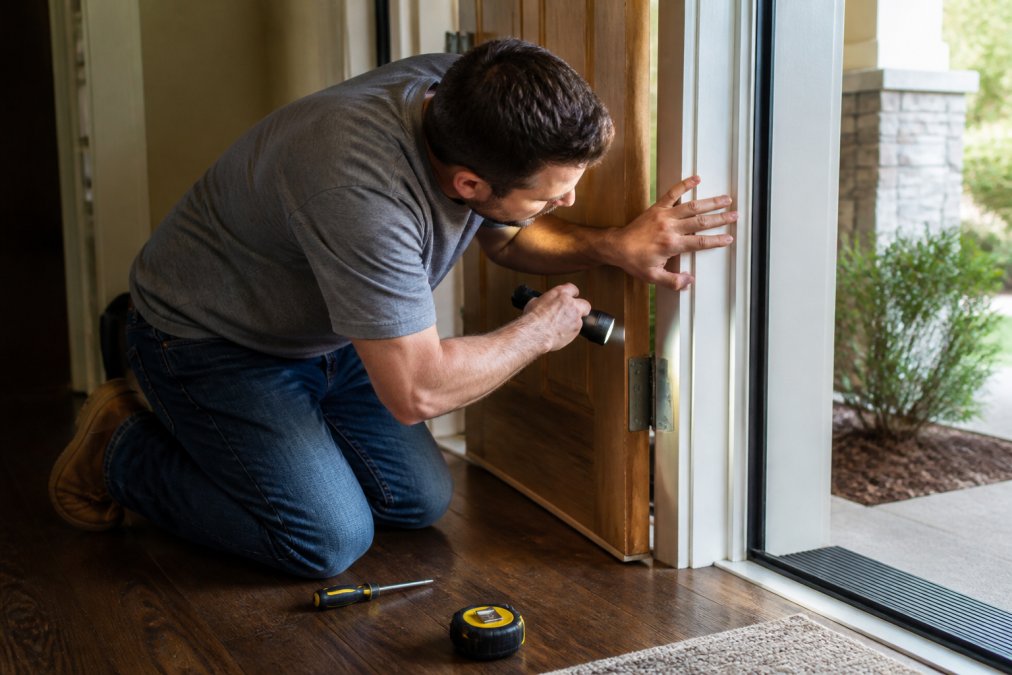
A homeowner kneeling at an open front door, running a hand along the door jamb and hinge side while holding a flashlight, with a screwdriver and tape measure resting on the floor nearby
- Open the door and check the gap along the top and both sides
- Push on the door near the lock and watch for frame movement
- Tighten or test every hinge screw with a screwdriver
- Remove one strike plate screw and measure its length
- Press a screwdriver into the wood near the bottom of the jamb
- Check for cracks around the strike plate and hinges
- Swing the door slowly and listen for scraping or rubbing
Tools You Need for a Non-Destructive Check
You don't need to cut, drill, or remove trim to inspect a frame. Everything here is non-destructive, which matters if you rent or plan to sell.
- A flashlight for shadow gaps
- A screwdriver for testing screws and wood
- A tape measure for gap spacing
- A level for checking plumb
- A pencil and paper for notes
Non-destructive testing is the biggest gap in most online guides: they tell you to check the frame but skip doing it without damage. These five tools cover a complete inspection.
What Each Test Result Actually Means
An even gap all the way around is normal. A gap that pinches at the top and widens at the bottom means the frame has shifted out of square, weakening the lock's engagement. A gap that widens when you push the door means the jamb is flexing and isn't anchored to the studs.
Door Armor Single Door Security Set →
A hinge screw that spins freely means the hole is stripped, a frame that will fail under load. A screw that holds firm but is shorter than two inches is still weak because it grabs only the jamb, not the stud.
When you press a screwdriver into the wood near the bottom of the jamb, resistance means the wood is sound. If the tip sinks in easily, moisture has compromised it.
Checking Wall Studs, Shim, and Rough Opening
The rough opening is the framed gap in the wall where your door unit sits. A prehung unit slides in, and installers use shims to fill the space between jamb and studs.
Door Type Differences: Hollow-Core, Solid-Core, and Metal Frames
The inspection steps are the same, but findings mean different things by door and frame type.
Watch Out: Strike plates installed with short screws are the number one reason doors fail during a kick-in. The screws pull straight out of the jamb because they never reach the stud.
Security vs. Fitness: What the Same Frame Can and Can't Do
A frame that passes a pull-up test is not necessarily secure. Pull-up bars test vertical load: your body weight pulls straight down, and the frame only resists gravity. A few hundred pounds spread across a header is well within what most frames handle.
How to Reinforce a Door Frame Before Someone Tests It
Reinforcing a door frame means transferring the load from the thin jamb to the wall studs behind it. That's the whole principle; everything else is method.
- The lock area, where the strike plate takes the hit
- The hinge side, where the door pivots under force
- The frame itself, which can split along the grain
Reinforcement Methods and What They Actually Do
Longer screws are the entry-level fix, reaching through the jamb into the stud. The trade-off: they don't reinforce the jamb itself, so a determined kick can still split the wood around them.
Prioritizing Fixes When Budget Is Limited
If you can't do everything at once, start with the lock area, where most kicks land. A security strike plate with three-inch screws is the highest-impact, lowest-cost fix.
Pro Tip: Install your reinforcement hardware before you paint or refinish the trim. The shields sit flush and match standard hardware finishes, so you won't need to touch up around them later.
When to Call a Professional
If the frame is out of square, the rough opening is damaged, or the studs are compromised, reinforcement hardware won't fix it. A carpenter or door specialist can re-shim the frame, replace damaged studs, or install a new door unit, beyond the scope of a screwdriver and a Saturday afternoon.
How to Install Door Armor on a Standard or Sidelight Door
Installation follows the same logic on every door type, but the hardware changes. Standard, sidelight, and double doors each have different weak points.
| Door Type | Main Weak Point | Door Armor Kit | Price |
|---|---|---|---|
| Standard single door | Strike plate and hinges | Single Door Security Set | $79.00 |
| Sidelight door | No true jamb to anchor | Side Light Door Security Kit | $129.00 |
| Double door | No center jamb | Double Door Security Kit | $149.00 |
For a standard door:
- Remove the existing strike plate and hinge screws
- Position the jamb shield over the lock area
- Drive the included fasteners into the studs
- Attach the hinge shields to the frame
- Test the door swing and lock alignment
When a Door Frame Is Fine for Fitness but Fails for Security
Best For: Renters and homeowners who want real security without permanent structural changes. Door Armor installs with screws and can be removed when you move.
If you've judged your door's strength by whether it flexes under a pull-up, you've been testing the wrong thing. Check the strike plate, hinge screws, and stud connection instead, those three points decide whether your door holds.
Frequently Asked Questions
How do you secure a door frame against kick-ins?
Start by inspecting the strike plate, hinges, and jamb for loose fasteners or cracks. Replace short hinge screws with longer ones that reach the wall studs, add a reinforced strike plate, and install steel jamb shields. Door Armor's Single Door Security Set uses galvanized steel to reinforce the lock and hinge side of the frame, and it comes with a $500 Lifetime Guarantee against kick-ins.
What are the common signs of a compromised door jamb?
Look for cracks in the wood around the strike plate, a door that no longer sits flush in the frame, visible gaps between the trim and the wall, stripped or loose hinge screws, and soft spots that signal rot from moisture damage. Any one of these signs of a weak door jamb means the frame may give way under force, even if the lock itself is solid.
Can a standard door frame hold up against forced entry?
Most residential door frames are built from softwood and held together with short finish nails, so they can split or pull away from the wall studs during a kick. A deadbolt helps, but it only protects as well as the jamb it sits in. Reinforcing the frame with steel plates and longer fasteners gives the door the structural integrity it needs to resist repeated impact.
Do door frames have studs, and why does it matter for security?
Yes. A properly built rough opening has wall studs on both sides of the door, and the jamb is attached to them with shims and nails. If your strike plate or hinges are only screwed into the jamb and not into those studs, the frame has far less load-bearing strength. Longer screws that reach the studs are one of the simplest ways to reinforce a door frame.