



Why Entry Points Matter After a Break-In
A burglary shatters your sense of security long after police reports are filed and damage is repaired. Most burglars return to the same property because they know the layout and what worked before, counting on you to patch visible damage without addressing underlying vulnerabilities.
Entry points are the weak links in your home's perimeter. Doors and windows are targeted because they're engineered for convenience, not maximum resistance. A standard door frame, basic deadbolt, and hollow-core door can be compromised in seconds. Ground-floor windows, sliding glass doors, and side-light entry doors present even greater risk due to lack of structural support.
Door Armor's analysis of thousands of break-ins shows a consistent pattern: burglars target the path of least resistance. By reinforcing entry points with proper hardware, frame reinforcement, and deterrents, you move yourself off the target list. An intruder will seek an easier mark rather than waste time on a door that won't budge.
The steps you take in the days and weeks after a burglary determine whether your home remains vulnerable or becomes hardened. This guide walks you through exactly how to strengthen entry points and prevent the next break-in.
How to Reinforce Front Door Frame and Lock Hardware
Your front door is the most common entry point for burglars. The problem isn't usually the door itself, it's the frame. Most residential door frames are installed with short screws that only penetrate hollow wood trim, not the solid framing behind it. When someone kicks a door, the frame tears away from the house structure in milliseconds.
Upgrading Your Deadbolt and Strike Plate
A standard residential deadbolt extends only one inch into the frame. When force is applied, the bolt breaks or the strike plate tears away. Replace your existing deadbolt with a heavy-duty model that extends at least one and one-quarter inches, made of hardened steel. Install a reinforced strike plate using four or more long screws that penetrate deep into the door frame studs, not just the trim.
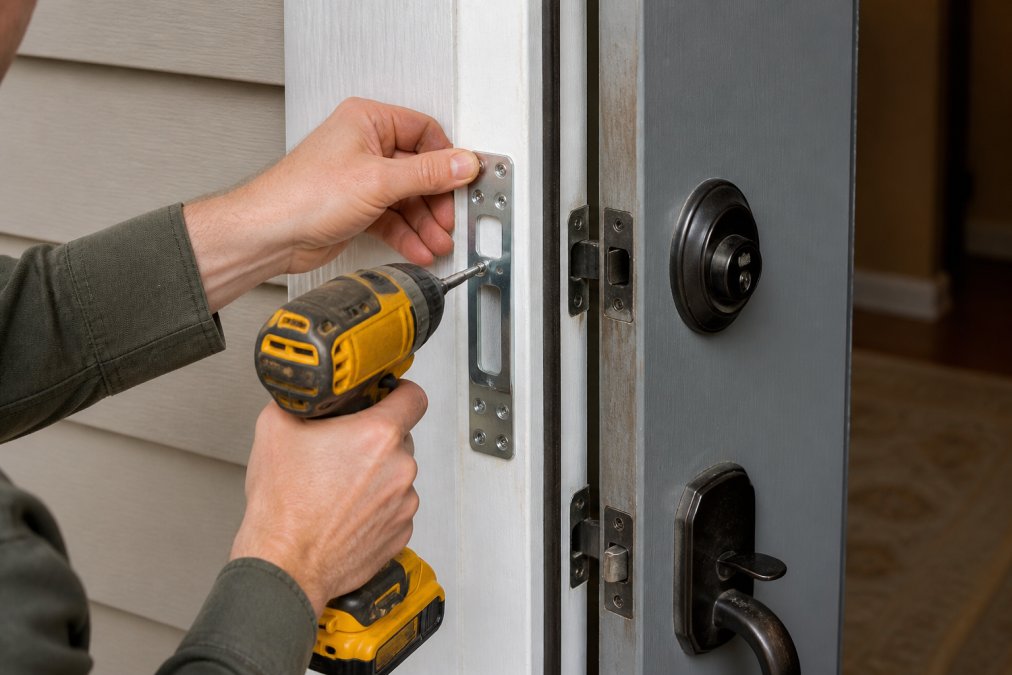
Homeowner's hands installing a reinforced strike plate and deadbolt on a residential front door, showing the hardware components and frame reinforcement clearly in natural daylight
Use screws at least three inches long to bypass hollow trim and anchor directly into solid wood framing. This single upgrade can be the difference between a door that holds and one that fails under pressure. Door Armor's Single Door Security Kit includes heavy-duty strike plate reinforcement designed for this purpose and takes about 15 minutes to install.
Reinforcing the Door Frame Itself
The hinge side of the door is equally vulnerable. Hinges are typically secured with short screws that hold only in the trim. Replace all hinge screws with long screws, at least three inches, that penetrate solid framing. Some homeowners add hinge shields, metal plates that distribute force across a wider area and prevent hinge pin removal.
If your door frame is hollow wood or thin composite, consider replacing it with solid wood or metal, which resists force better. If you have a hollow-core door, replacing it with a solid core or solid wood door is one of the most effective upgrades. Solid doors don't flex when struck.
Frame reinforcement involves three actions: upgrading hinges and their screws, installing hinge shields if needed, and ensuring the door itself is solid enough to resist impact.
Securing Ground-Floor Windows and Vulnerable Access Points
Windows are the second most common entry point, especially on ground floors. Most residential windows are secured only by a simple latch designed for convenience, not security. An intruder can break the glass or pry the frame open in seconds.
Ground-floor windows need multiple layers of protection. Start with security film, a transparent adhesive layer applied to the inside of the glass. It doesn't prevent breaking, but holds broken pieces together, making it much harder to create an opening large enough to climb through.
Install heavy-duty window locks with keyed mechanisms that require a key to open. For sliding windows, add a vertical bolt or pin lock that prevents horizontal sliding. Sliding glass doors present even greater risk and often serve as the primary entry point at the back of a home.
Consider security grilles or bars on particularly vulnerable windows. They're more visible than other options but most effective. If aesthetics matter, removable grilles can be installed only at night or when unoccupied.
Motion-activated lighting outside ground-floor windows removes the cover of darkness burglars depend on. Combined with visible security system signage, outdoor lighting creates the impression that the home is monitored.
How to Secure Sliding Glass Doors
Sliding glass doors are common vulnerabilities because they're large, visible from the street, and often located at the back where neighbors can't see an intruder. The typical sliding door lock is a simple latch that can be lifted off its track or pried open with a flathead screwdriver.
Install a vertical bolt or door rod that prevents the door from sliding. These devices run from the top of the door frame to the bottom, creating a rigid barrier. Installation takes minutes and requires only basic tools.
For added security, install a sliding door deadbolt, a keyed lock that secures the door in the closed position. Door Armor's Armor Latch Sliding Door Deadbolt is specifically designed for this purpose and can be installed without professional help.
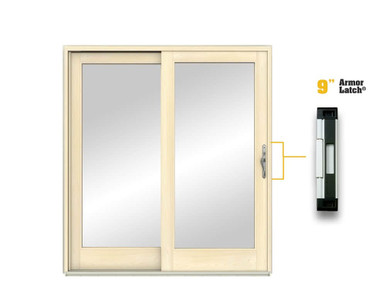
Reinforce the door frame using the same principles as front doors: long screws through hinges or rollers, and frame reinforcement that distributes impact force across solid framing. For sliding doors with side lights, Door Armor's Side Light Door Security Kit addresses this specific problem with a jamb shield that screws directly into frame studs.
Best Door Security Devices for Home Protection
After a burglary, you have several options for reinforcing doors. The right choice depends on your budget, door type, and how much installation work you're willing to do yourself.
Door reinforcement kits combine multiple components into a single system, typically including a reinforced strike plate, hinge shields, and sometimes a door brace or wedge. Door Armor's Single Door Security Kit ($79) is the most popular option for standard entry doors. It includes strike plate reinforcement, hinge shields, and all necessary hardware for installation in under 30 minutes, with a $500 Lifetime Guarantee against kick-ins.
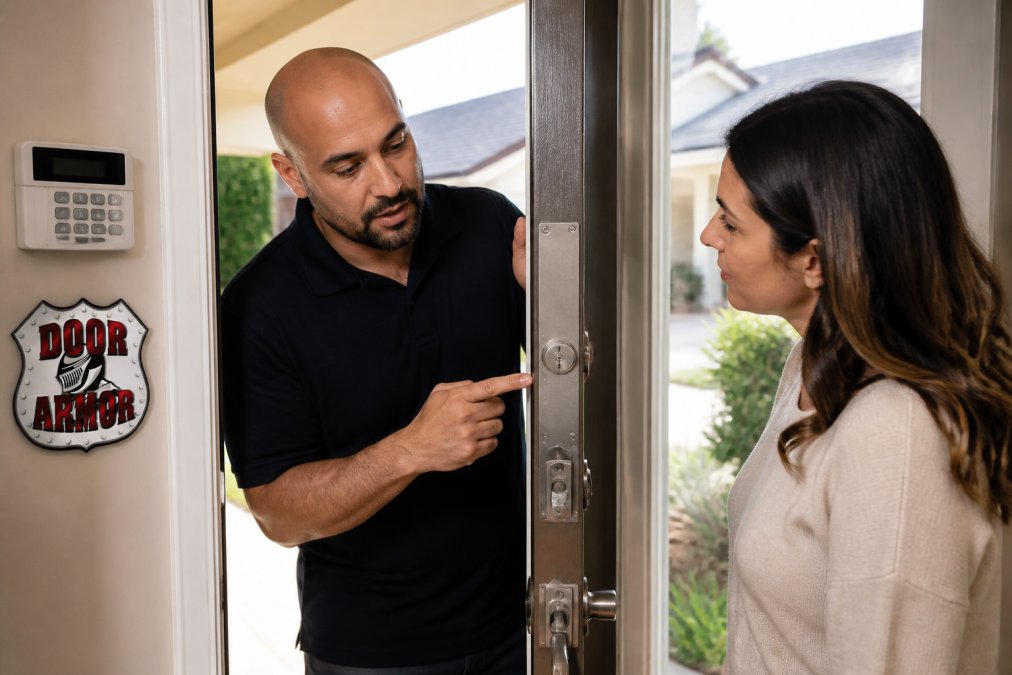
A residential entryway displaying multiple security solutions: reinforced door frame with long screws, heavy-duty deadbolt, strike plate reinforcement, and security system keypad on the wall, showing a comprehensive home protection setup
For double doors or French doors, Door Armor's Double Door Security Kit ($149) uses a night lock system that secures both doors together, preventing them from being pried apart.
Sliding glass doors require specialized hardware. A vertical bolt or door rod costs $20-40 and takes 10 minutes to install. For more security, a keyed sliding door deadbolt like the Armor Latch ($39.99) prevents the door from being forced open.
Door braces and wedges are temporary solutions best used as supplements to other security measures, not as primary solutions.
Security doors, solid metal doors with reinforced frames, are the most expensive option at $500-1,500 installed but provide maximum protection. For most homeowners, a combination of reinforced hardware and smart deterrents is more practical.
The key is layering: a solid door, reinforced frame with long screws, heavy-duty deadbolt, reinforced strike plate, and visible deterrents like alarm system signage and outdoor lighting.
Immediate Steps to Take After a Burglary
Call police and file a report. Don't clean up or move anything until police complete their investigation. Take photos of all damage and missing items for your insurance claim. Document the entry points used: which door or window, how it was forced, and what damage resulted.
Secure the entry point immediately. If a door lock is broken, install a temporary brace or wedge. If a window is broken, board it up or cover it with plywood. Temporary fixes are fine; permanent reinforcement can happen over the next few days.
Change your locks or rekey them if concerned the burglar obtained keys. This typically costs $100-200 but provides immediate peace of mind.
Review your security with fresh eyes. Walk around your home and identify other vulnerable entry points. If the burglar used your front door, check your back door, side doors, and ground-floor windows. Fix the most obvious vulnerabilities first, then work through others systematically.
Install temporary alarm system signage even if you don't have an alarm system. Many burglars will move to an easier target rather than deal with a home that appears monitored.
Document everything for your insurance claim. Keep receipts for all repairs and security upgrades. Photograph damage before repairs are made.
DIY vs. Professional Installation: What Makes Sense
Most homeowners can install door reinforcement hardware themselves. Door Armor's products are designed for DIY installation and take 20-30 minutes per door. You need basic tools: a drill, screwdriver, and measuring tape.
The advantage of DIY installation is cost savings and immediate action. You can secure your home the same day you decide to do it.
Professional installation makes sense for multiple doors or complex security needs. A security professional can conduct a vulnerability assessment and recommend the most effective upgrades for your specific home layout.
For renters or temporary residents, DIY installation is the only practical option. Door Armor's products can be installed and removed without damaging the door or frame.
A homeowner who installs basic reinforcement themselves is far more secure than someone waiting months for a contractor. Start with what you can do immediately, then add professional work if needed.
Cost comparison: A DIY single-door reinforcement kit costs $79-150 and takes 30 minutes. Professional installation of the same system might cost $200-400 in labor alone.
Documentation and Insurance Considerations
Your insurance claim depends on documentation. Photograph all damage before repairs are made, including wide shots and close-ups of the specific entry point. Document the value of stolen items with descriptions, approximate purchase dates, and estimated values. Include serial numbers if available.
Keep receipts for all repairs and security upgrades. These receipts prove you've taken steps to prevent future break-ins, which can lower your insurance premiums in some cases.
Provide your insurance company with a copy of the police report. Some policies require a police report before processing a claim.
Take before-and-after photos of all security upgrades to demonstrate you've addressed vulnerabilities and taken reasonable preventive steps.
Keep a record of all communications with your insurance company, including dates, names of representatives, and discussion topics. This documentation is valuable if there's a dispute about your claim.
The aftermath of a burglary is stressful, but it's also an opportunity to address vulnerabilities you might have ignored before. Strengthening your entry points isn't just about preventing the next break-in, it's about reclaiming your sense of security and control over your home.
Door Armor's police-tested security systems are designed specifically for homeowners who've experienced a break-in and want to ensure it doesn't happen again. With a patented galvanized steel reinforcement system that installs in under 30 minutes and comes with a $500 Lifetime Guarantee, Door Armor stops forced entry at the weak points where burglars typically attack. Get started with Door Armor and transform your vulnerable entry points into genuine barriers against intrusion.
Frequently Asked Questions
What's the most common entry point for burglars?
Doors are the primary target, particularly front and back doors without reinforcement. Burglars exploit weak door frames, cheap deadbolts, and strike plates that aren't properly secured. Windows on ground floors and sliding glass doors are secondary targets. After a burglary, strengthening these entry points is critical to prevent another break-in at the same vulnerabilities.
How do you reinforce a door so it can't be kicked in?
Start by upgrading your strike plate to a heavy-duty version with longer screws that reach the door frame studs. Install a quality deadbolt rated for forced entry resistance. Then reinforce the door frame itself using galvanized steel reinforcement systems that distribute the force of a kick across a larger area. These solutions work together to make forced entry extremely difficult and time-consuming for an intruder.
Are deadbolts alone enough to prevent forced entry?
No. A deadbolt is only as strong as the strike plate and door frame supporting it. Many burglaries succeed because the strike plate pulls away from the frame during a kick. You need to reinforce the entire entry system: the deadbolt, the strike plate, and the door frame itself. Combined, these components provide genuine forced entry protection.
Can I install door security devices myself, or do I need a professional?
Most homeowners can install door security devices themselves in 30 minutes or less. Reinforcement systems like those from Door Armor are designed for DIY installation with basic tools. However, if your door frame is damaged from the burglary or you're uncomfortable with installation, a professional can ensure proper setup. DIY installation saves money and gives you control over the timeline.